Most stool orders that go sideways do so for one boring reason: the seat is the wrong height for the worktop. It is the first thing we pin down on an enquiry, and the one figure buyers most often guess at. So before you pick a seat shape or a finish, measure the bar.
The three heights, in real numbers
There are three working heights, and they exist because there are three common worktop heights. A counter stool has a seat around 610-740 mm (24-29 in) and suits a kitchen-island or counter top around 900 mm. A bar stool has a seat around 760-810 mm (30-32 in) for a standard bar top of about 1050-1100 mm (40-42 in). A spectator (extra-tall) stool sits higher again, roughly 840-910 mm, for the raised bars you see overlooking a kitchen pass or a gaming table.
The rule that ties it together is legroom. You want roughly 250-300 mm (about 10-12 in) of gap between the seat top and the underside of the worktop, so a person can cross their legs and slide in. Measure from the finished floor to the top of the worktop, subtract that gap, and you have your seat height. Tell us the worktop figure and we work the rest backwards — that is far safer than you reading a seat number off a competitor's listing that may be measured differently.
Where gas-lift changes the math
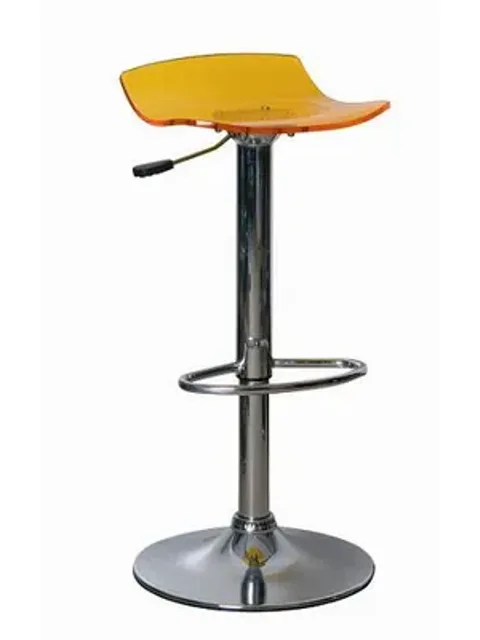
A fixed stool gives you one height, chosen on purpose. A gas-lift stool adjusts — ours typically run a 600-800 mm seat range on a Class 3 or Class 4 cylinder — and one model can then cover a counter and a bar in the same venue. That flexibility has a cost we are honest about: it is a moving part that can sink or wear, and in a packed public bar that is one more thing to service. For a fit-out that mixes counter and bar zones, gas-lift earns its keep; for a single fixed bar height that never changes, a fixed stool removes a failure point. We make both, and the choice belongs to the venue, not the catalogue. The detail lives on our bar stool category page.
Spacing and elbow room, not just height
Height gets a stool to the right level; spacing decides whether the room actually works. As a planning figure we use about 600-700 mm of bar length per stool, centre to centre. Crowd them tighter and guests knock elbows and bags; space them wider and you lose covers. For a straight run, count the usable bar length, divide by 650 mm, and round down — that is your honest stool count, and it is often two or three fewer than a buyer first hopes for. Corners eat space too: leave a stool-width gap at an inside corner or two people end up shoulder-to-shoulder at ninety degrees.
Backrests and arms change the math again. A backless stool tucks fully under the worktop and disappears when not in use, which is why high-turnover bars love them; a stool with a back or arms needs more clearance and will not slide all the way under. Neither is wrong — but a venue that wants the floor clear for cleaning each night should know a backless or low-ring stool is the one that gives it back the space.
Mixing heights in one venue
Most real fit-outs are not one height. A hotel might run counter stools at the breakfast island, bar stools at the lobby bar and a couple of spectator stools at a feature ledge. The mistake we see is ordering one stool model and hoping it covers everything; the fix is either a gas-lift model that spans the range or a small family of fixed heights built on the same base and seat so the room still reads as one set. We would rather build you three fixed heights that match than one compromised height that fits nothing properly, and we will say so on the quote.
What we actually need from you
Three numbers and we can quote a height without a back-and-forth: the worktop height from the floor, whether the seat should be fixed or adjustable, and the rough user mix (a hotel breakfast bar and a late-night cocktail bar carry different weights and use patterns). If you are also fitting tables, send those too — we make matching dining chairs and bar tables so the heights line up across the room, and the broader range sits on our products page.
One field note that saves returns: stool seat heights are measured to the top of the uncompressed seat. A thick foam pad can lose 15-25 mm once someone sits on it, so a "760 mm" padded stool can ride lower in use than a hard-shell one of the same nominal height. We state the measured-and-compressed figure on padded models when it matters for a tight worktop. If you want us to spec a full room, send the plan through our contact page or email [email protected] and we will set every height to your worktops.