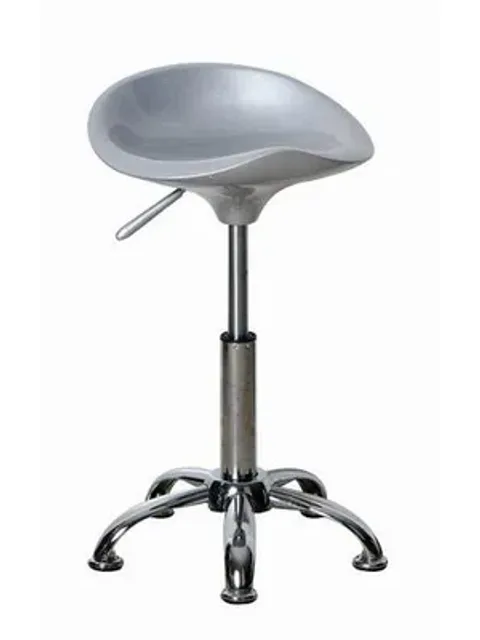
Two stools can share a seat shape and a finish and still be 100 kg apart on load rating. One is a home stool that gets sat in by the same few people a few times a day; the other is a contract stool that takes a fresh body every twenty minutes across a fourteen-hour service. The price gap between them is not margin — it is steel, weld and test cycles. Here is what the rating actually covers.
The numbers buyers should hold in their head
As a rough industry frame: a residential stool typically rates around 110-136 kg (250-300 lb) static load. A commercial stool runs higher — commonly 136-227 kg (300-500 lb) — and for a genuinely high-traffic bar, fit-out specifiers ask for stools rated at the top of that band. The static number is only half the story. A contract rating also implies the frame survives a cyclic test — repeated loading that stands in for years of people dropping into the seat — not just one person standing on it once.
"Contract grade" is the phrase to listen for. It means the piece is built for continuous, intensive use: heavier gauge tube, fully welded joints rather than bolted-and-hoped, and a base weighted and sized so the stool does not tip when someone leans back on the footrest. None of that shows in a catalogue photo, which is exactly why the rating exists.
Why does a public bar genuinely need the higher number, when no single guest weighs 200 kg? Because the rating is a safety margin against a lifetime of abuse, not a measure of the heaviest guest. A contract stool is sat on by a fresh body every twenty minutes, leaned on, stood on to reach a shelf, dragged across the floor and occasionally sat on by two people at once. The static rating buys headroom so that years of that treatment do not walk the welds loose. A home stool that sees gentle use a few times a day never accumulates that fatigue, which is why a 250 lb home rating is honestly fine there and overkill nowhere it matters.
Where the extra load actually goes
On our bar stools the load path runs seat → column → base, and the footrest takes its own abuse. We push the rating up by three boring moves: thicker wall on the steel tube, continuous welds at the column-to-base joint instead of tacks, and a base diameter and weight matched to the seat height so a tall stool does not get tippy. A spectator-height stool needs a wider, heavier base than a counter stool for the same stability — physics, not preference. The weld is the part that decides it: a tacked joint can pass a one-off load test and still fatigue loose over a year of being dragged and leaned on, while a continuous weld carries the cyclic abuse that a public floor actually delivers.
Tip stability is a separate failure mode
A stool can pass a static load test and still be dangerous, because tipping is not the same as crushing. People lean back, hook a foot on the ring and rock, or push off the bar to stand. A tall stool with a narrow or light base will go over before it ever reaches its rated load — and a fall from an 810 mm seat is a real liability, not a scuffed floor. That is why base diameter and weight scale with seat height on our range: a spectator stool gets a wider, heavier base than a counter stool, even though both might quote the same user-weight rating. When you compare suppliers, ask for the base diameter and weight, not just the load number.
How to read a rating claim
A bare "300 kg" on a listing tells you almost nothing on its own. Ask three follow-ups. Is it a static load (one push) or does it come with a cyclic result (repeated loading that stands in for years of use)? Was it tested on the exact configuration you are buying, or on a different seat and base? And is there a report, or is the number marketing? A genuine contract supplier can answer all three without flinching. We would rather you ask us those questions than discover the gap after a container lands.
How we rate and test it
We build and test our stools and swivel chairs to BIFMA / EN reference loads, with standard models in the 110-120 kg user-weight band and heavier-duty builds available where a venue needs them. We can test to a figure you specify and arrange a third-party report for your model — we do not print a certificate we do not hold. If your project is a public bar rather than a home kitchen, tell us the expected footfall and we spec the gauge and base to suit; the way we run an order start-to-finish is on our about page, and you can send a brief through contact or to [email protected].