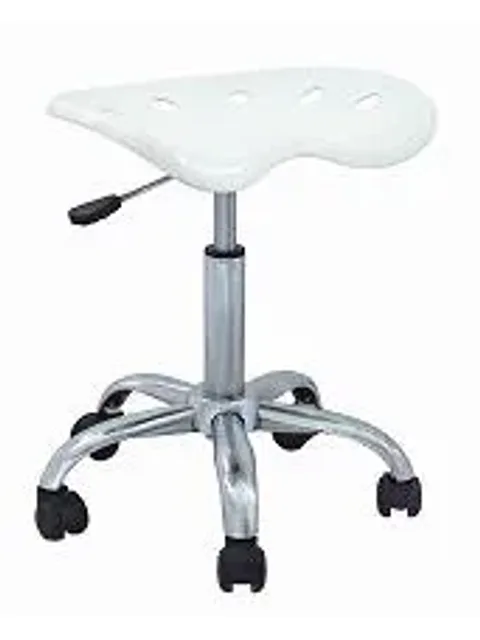
Buyers who come to us from the office-furniture world sometimes ask whether our stools are "EN 1335 certified." They are not, and they should not be — EN 1335 is the office-chair standard. A bar stool is hospitality seating, and the European test that fits it is EN 16139, the non-domestic seating standard. Getting the right standard named on the brief saves you paying for the wrong test.
What each standard actually covers
EN 16139 specifies the safety, strength and durability of all types of non-domestic seating intended for adults — and it explicitly includes swivelling chairs and stools, which is exactly our range. The useful part for a buyer is that it comes in severity levels: L1 for general use, and L2 for severe or extreme use. A quiet hotel lobby bar can sit at L1; a high-turnover public bar or a venue that wants headroom should ask for L2. Same standard, harder test.
On the North-American side, BIFMA is the reference family, and ANSI/BIFMA X5.1 is the general-purpose office-chair test most buyers name. It runs structural and cyclic abuse — seating-impact drops, swivel cycling, base and leg strength. For a stool sold into the US, a buyer's specifier may reference BIFMA test methods for the load and durability clauses. The point is the same as in Europe: match the test to the destination, not to whatever certificate sounds most impressive.
It is worth being clear on what the levels do and do not promise. EN 16139 L1 versus L2 is about severity of use, not about whether the product is "better" — an L1 result is perfectly correct for a low-traffic setting, and paying for L2 there is buying a number the venue never tests. The same trap exists across borders: building one stool to clear both EN 16139 L2 and the toughest BIFMA load class is possible, but it means tooling the base, cylinder and frame to the stricter of the two on every parameter, and you pay for that in unit cost even in the market that did not ask for it. If you sell into one region, we spec to that region; if you sell into both, we tell you the cost delta of the combined build before you commit.
Why we will not just say "certified"
A stool is not certified in the abstract. It is built and tested to a named standard, at a named severity, for a named market — and the result is only valid for that configuration. Knowing how to verify a supplier's certification claims before you sign off a sample is the practical skill that separates a clean order from a dispute at the port. Change the seat from a hard shell to a deep foam tub, or swap a Class 3 cylinder for a Class 4, and a previous report may no longer represent the unit you are buying. That is why we say our bar stools and swivel chairs are built and tested to BIFMA / EN reference loads, and that a formal third-party test can be arranged per order, rather than printing a blanket "certified" line.
What the test actually does to a stool
It helps to picture the abuse. A durability test cycles the seat and back tens of thousands of times to stand in for years of people dropping into the seat. A stability test loads the stool toward each edge to check it will not tip — which, for a tall bar stool, is the clause that matters most. Static and impact tests overload the seat and the footrest in one hit to find the weak weld. Leg and base strength tests push the structure sideways. A stool that survives all of that is one we have built with continuous welds and a base sized for its height — which loops back to why a contract stool costs more than a home one that only ever has to look right.
The specs that travel alongside the seating test
For hospitality, the strength standard rarely travels alone. Depending on the market and the venue, a buyer may also need a fire result on the upholstery and foam (the UK, for instance, has its own furniture fire rules) and a chemical declaration such as REACH for the European market. We do not pretend these are the same as the seating test, and we do not bundle them into a vague "certified" word. If your project needs them, tell us early: the foam and fabric we select for a fire-rated job are chosen at the sample stage, not swapped in afterwards, and the same is true for low-emission finishes.
How to put it on the brief
Two decisions up front keep the timeline clean. First, name the market so we know whether you need EN 16139 (and at L1 or L2) or BIFMA test methods. Second, decide whether the report should be run on the production unit or on a representative sample, because that changes when the lab work happens and what it costs. We bake the test booking into the sample stage so nothing surprises you at shipment — the workflow is on our ODM/OEM page, and the short version is in the FAQ. Send the destination and target quantity through contact and we will map the standard and the cost to it.