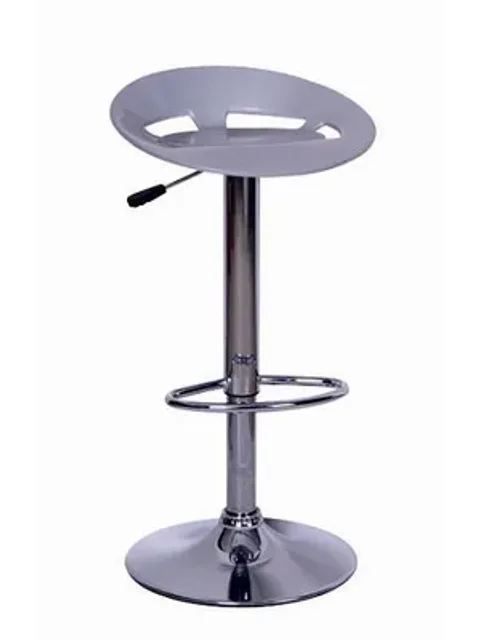
A café or restaurant rarely orders only stools. To finish a hospitality fit-out we build steel-tube dining chairs that pair with the bar stools, and the first question on those is almost always: stackable or fixed? It sounds like a storage detail. It is actually a decision about your labour, your freight and your replacement cost over the chair's whole life.
What stacking actually saves
The obvious win is footprint — stacked chairs take a fraction of the floor or store space, which matters for a venue that clears the room for cleaning, events or function changeovers. But there are two quieter savings. First, cleaning and inspection: individual chairs that stack are far easier to deep-clean, flip and inspect than fixed banquette runs, and a damaged chair can be pulled and replaced on its own. Second, freight: chairs that stack or nest pack tighter, so more units fit a 40-foot container and your landed cost per chair drops. On a large order that container math is not a rounding error.
That freight saving compounds over the life of the order, too. A chair that ships flatter or nested is also a chair that is cheaper to re-order — when a venue needs another twenty to replace damage or extend the room, those top up into a part-container far more efficiently than a bulky fixed chair. And a stackable chair is easier to redeploy: a venue that re-lays its floor for a function can move and re-set a stacked set in minutes, where fixed seating is effectively a build. For an operator running events, that flexibility is worth real labour every week.
Where a fixed chair earns its place
Stacking is not free of trade-offs. A chair designed to stack has to keep its arms and back profile within the stacking envelope, which limits some shapes; and stacked frames can scuff each other over time if they are stacked carelessly or too high. A fixed (non-stacking) chair can carry a more sculpted back or a heavier, more premium presence — which is why a fine-dining room or a hotel signature restaurant often specifies fixed seating and accepts the higher storage and shipping cost for the ambiance. There is no universally right answer; there is a right answer for your room and your turnover. A useful middle path some venues take is stackable chairs in the everyday dining areas and a small run of fixed, sculpted chairs in the signature space — same finish, same supplier, two specs.
How high is safe to stack
Stacking has a ceiling, literally and for safety. Most steel-tube hospitality chairs are rated to stack somewhere in the range of six to ten high before the tower gets unstable and the bottom frames carry too much weight — and a leaning stack of chairs is a hazard in a busy back-of-house. Two practical moves keep it sane: tell staff a safe stack height and stick to it, and for venues that store a lot of chairs, order a stacking trolley so a tall stack rolls on a wheeled base instead of being balanced on the floor. We can quote a trolley with the chairs so the venue is not improvising on day one.
One supplier for stools and chairs
There is a procurement angle that has nothing to do with the chair itself. When the stools and the matching dining chairs come from the same factory, you get one finish batch (so the chrome or colour actually matches across the room), one quality standard, one set of cartons and labels, and one container instead of two part-loads from two suppliers. Consolidating to fewer vendors cuts the freight, the paperwork and the finger-pointing when something is off. Because we make bar stools, swivel chairs and dining chairs under one roof, a hospitality buyer can fit a whole room from one purchase order.
How we build and ship them
Our standard dining chair uses a bent Ø19 × 1.2 mm steel-tube frame in the same chrome or powder-coat finish as the stool bases, so a venue reads as one set. The standard frame stacks; we build a non-stacking version where a buyer wants a particular back shape. Seats are upholstered PU or a moulded PP shell, with a back rake around 15° for sitting through a meal, and seat height around 460 mm. Because these are drawing-built, the back shape, finish and stacking behaviour all follow your spec rather than a fixed catalogue line — the range is on our products page.
If you are ordering stools and chairs together, we pack them into a mixed container to maximise the count — that is part of how OEM works here. Send the room plan, the look you are after and the rough quantities through our contact page or to [email protected], and we will tell you honestly where stacking helps you and where a fixed chair is the better buy.