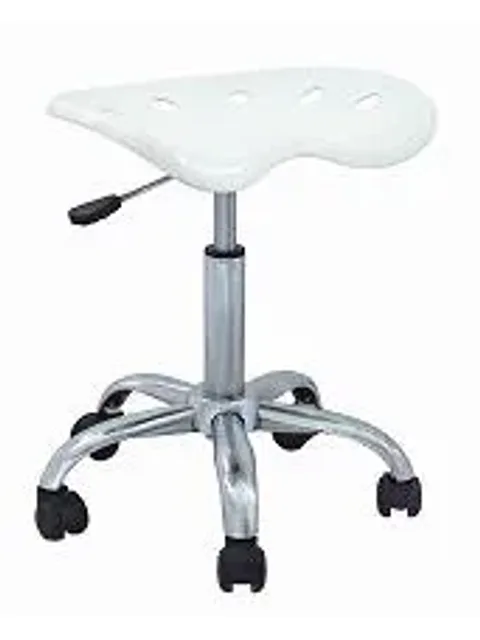
Walk into a busy bar three years after the fit-out and look at the stools. The frames are fine — a welded steel frame that passed its load tests barely notices three years of service. The seats are not: PU shows scuffs and cracked stitching, fabric is stained, plastic shells are scratched white at the edges. The venue's instinct is to budget for new stools. The cheaper answer, most of the time, is to budget for new seats — and that only works if somebody set the order up for it on day one. This is how we run it.
Why the economics favour seats
On a typical upholstered bar stool, the seat assembly is roughly a third of the FOB value; the frame, finish and mechanism carry the rest. So a venue replacing seats instead of whole stools is already starting at about a third of the unit cost. Freight then widens the gap: assembled stools ship mostly air, while seat pans and shells nest, so the same container volume carries several times as many seats as complete stools. Add that nobody has to dispose of fifty steel frames, and the refurb route usually lands at well under half the cost of rebuying — for a result the guest cannot tell apart, because the only part a guest ever touches or sees up close is the part you just renewed.
There is a second-order benefit venues rarely price: downtime. Swapping a four-bolt seat is a five-minute job with a hex key, done section by section on a quiet morning. Replacing whole stools means receiving, unboxing, assembling and disposing — a project, not a maintenance task.
The fixing pattern is the whole program
Everything above depends on one boring detail: the new seat has to land on the old frame's holes. Stool seats attach a few standard ways — a four-bolt plate on rigid frames, a swivel plate with its own bolt square on swivel seating, or a ring clamp on some shell designs. Within those families, hole spacing varies by maker and even by production year. If your original order never recorded the pattern, your "replacement" seats arrive as fifty almost-fitting parts and a drilling job.
So when we set a stool program up for aftermarket service, we do three unglamorous things. We freeze the seat-fixing drawing as part of the order pack, with the bolt pattern, thread size and plate thickness dimensioned. We keep the drawing and the tooling references against your SKU, so a reorder five years on matches a frame we shipped five years ago. And we mark the underside of the seat and the top of the frame plate with the pattern reference, so a maintenance contractor who has never spoken to us can identify what fits. None of this costs anything at production time. All of it is impossible to reconstruct afterwards.
What goes in a refurb kit
Seats are the headline, but the parts that actually age a stool are smaller. A refurb kit we would quote for a three-to-five-year-old installation typically holds: the seat assembly; a set of glides or floor pads, because those are worn flat or lost; a footrest-ring sleeve or replacement ring where the plating has worn through — the wear sequence we wrote up in our piece on footrest and swivel wear; and fresh fixings, because reused bolts on a part that gets sat on are a bad habit. For gas-lift models the kit can include a cylinder, which turns a sinking stool back into a working one for the price of one part.
The kit format matters for the venue's side of the job: one box per stool, everything inside, no counting washers across a pallet. A bar manager can hand a box and a hex key to anyone on the team.
Spares with the original order, or a reorder later
There are two ways to run the program and we quote both. The first is attrition spares: add 5-10 percent loose seats and a bag of glides to the original container. It costs little, rides in the same freight, and covers the first years of cigarette burns and box-cutter accidents. The second is the planned refresh: a reorder of seats and kits in year three or four. That one lives or dies on dye lots and finishes — a reordered PU or fabric will be a near match, not a perfect match, to three-year-old upholstery, so we advise venues to refresh a whole room or a whole zone rather than mixing old and new seats along one bar. We will say that on the quote rather than let a mismatch become a complaint.
One honest limit: a refurb program cannot rescue a frame that was wrong to begin with. Cracked welds, rusted-through tube or a bent column mean the stool is done, and we would rather tell you that from photos than sell you seats for scrap frames.
Setting it up
If you are placing a new stool order, ask for the fixing drawing and the attrition-spares line on the same quote — it is part of how OEM works here. If you are holding someone else's three-year-old stools, send us photos of the seat underside and the frame plate with a tape measure in frame, and we will tell you whether a retrofit seat is practical. Either way the thread starts at the contact page or [email protected].