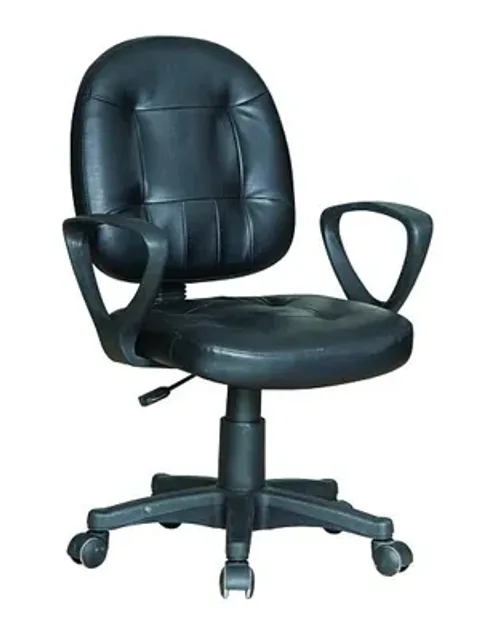
Ask a venue manager which part of a bar stool fails first and they will not say the seat. It is the footrest and the swivel. Nobody sits on a footrest — everybody stands on one, every time they get up, with their full weight on a ring 380 mm off the floor. And the swivel is the single most stress-prone joint on the whole stool. So those are the two parts we over-build, because they are the two that decide whether your stool lasts two years or seven.
Why the footrest ring takes the punishment
A footrest is a lever. When a person pushes up to leave the stool, they load the ring at its front edge, repeatedly, with a twisting force. A cheap stool handles this with a chrome ring press-fit into the column — pushed on, held by friction. It looks identical to a good one on day one. By month six the friction joint has loosened, the ring spins or drops, and the chrome wears through where shoe soles scuff it.
On our bar stools the footrest is chromed steel welded or mechanically clamped to the column, not press-fit trim, and for heavy venues we offer a thicker-gauge hoop. It costs a little more in steel and labour. It also stops the most common warranty call we hear about from buyers who switched suppliers on price.
There is also a height question on the footrest itself. A ring set too high cramps the knee; too low and feet dangle and the stool feels unsupported, which sends people to perch on the ring edge — accelerating the wear. We set the footrest roughly 380-450 mm below the seat depending on the stool height, which keeps the knee comfortable and the load over the strong part of the ring. On a tall spectator stool that gap is bigger, so the ring carries more leverage and we step up the gauge accordingly. It is the kind of detail that does not show in a render but decides whether a guest is comfortable through a long evening.
The swivel: steel bearing, not a plastic bush
The swivel plate is what lets the seat turn under a seated adult, smoothly, thousands of times. The honest divide here is steel ball-bearing plate versus moulded plastic bush. A plastic bush is cheaper and turns fine in the showroom; under a real body it develops play, then grinds, then seizes. We use a 360° steel ball-bearing plate on our swivel stools and swivel chairs, and we test the swivel as part of the assembled chair rather than as a separate component claim, because a swivel that passes on the bench can still bind once it is bolted into a base.
The glide where the base meets the floor
There is a third quiet wear point: where the base touches the floor. A weighted trumpet or disc base sits on glides, and on a hard floor those glides are what stop the base ringing, scratching and walking out of position as people shove the stool. Cheap stools skip them or use a bare metal foot that gouges a timber or tile floor within weeks. We fit felt or nylon glides as standard and offer a heavier non-marking glide for stone and engineered floors. It is a small part, but a venue manager notices the scratch ring on a polished floor long before they notice anything else about the stool.
How to inspect it on the sample
Before you sign off a pre-production sample, do three things by hand. Grab the footrest ring and try to twist and pull it — a welded or clamped ring will not budge; a press-fit one will give. Sit on it and spin hard, then stop suddenly — a steel bearing returns to smooth; a plastic bush will feel notchy or noisy. And tip the stool onto its glides on a hard surface and push it around — listen for ring and check for marks. These take two minutes and they tell you more than any spec sheet. We expect buyers to do exactly this, and we send samples built to be inspected, not staged.
The trade-off, stated plainly
You can save a few cents per stool on a press-fit footrest and a plastic swivel, and across a 40-foot container that is real money on paper. It comes straight back as ring replacements, freight on spare parts and a reseller who stops reordering. For a low-use home stool, the cheap parts are genuinely fine and we will sell them to you. For a public bar floor, we push you to the welded ring and the steel bearing and explain why. If you want the durable spec on the models that carry your brand and the budget spec elsewhere, that split is exactly what OEM here means — browse the full range or reach us through the contact page or [email protected].