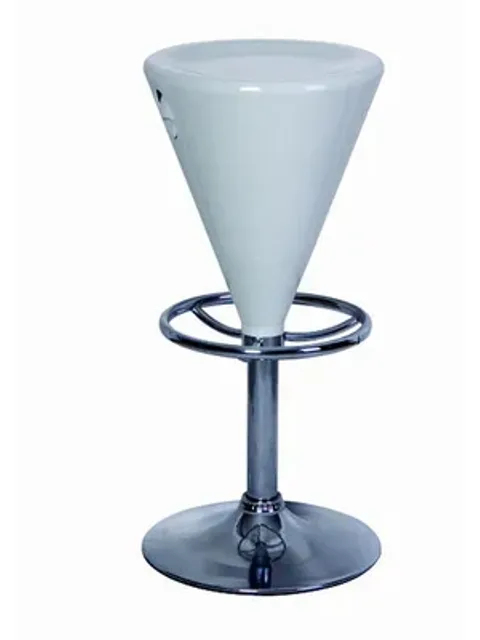
On a bar stool, the gas cylinder is the part a price-driven supplier quietly swaps to save money, because the buyer almost never sees the stamp on the steel. It is also near the top of the list when a stool fails on site — and a faulty cylinder is not just a service inconvenience; a gas-lift column that fails under load is a safety issue, which is why understanding gas-lift safety standards matters before you specify. So when we quote an adjustable bar stool, the cylinder class is one of the first things we lock, not the last.
What gas-lift buys you, and what it costs
A gas-lift column does two jobs: it adjusts the seat height across roughly a 200 mm range, and it lets the seat swivel on a bearing. For a venue that mixes counter and bar zones, or where staff move stools between layouts, that flexibility is worth real money. The cost is honest: a cylinder is a sealed moving part. Over years of public use the seals wear, and a tired cylinder sinks under load or refuses to hold height. In a 24/7 bar that is a service item.
A fixed-height stool removes that part entirely. No cylinder, nothing to sink, nothing to replace — just a welded column at one chosen height. For a bar that never changes its worktop height, a fixed stool is often the more durable, lower-maintenance answer, and we will say so even though the gas-lift version usually carries a higher price.
Class 3 vs Class 4, in plain terms
If you do go adjustable, the cylinder class is the number that matters. In rough figures a Class 3 cylinder is rated around 120 kg and suits lighter, intermittent use; a Class 4 is built for roughly 150-180 kg and harder duty — shared seats, long services, heavier average users. The jump is not only maximum weight; the higher class also tolerates more up-down cycles before it starts to sink.
The stamp matters as much as the class. A genuine cylinder carries a mark on the steel — often a TÜV or SGS reference with the class — and you can ask for that photo before production. We would rather you check it than take our word for it. A "Class 4" claim with no stamp is just a word.
One more detail people miss: stroke and column diameter. Two Class 4 cylinders can have different travel — a longer stroke gives a wider seat-height range but a taller minimum, which can matter under a low counter. And a thicker piston rod resists side-load better, which is exactly the abuse a bar stool gets when someone leans sideways off the seat. When we set a gas-lift stool, we match the stroke to the worktop you gave us and pick a rod diameter suited to the duty, rather than fitting whatever cylinder is on the shelf. If you need a specific adjusted range — say a fixed counter at 660 mm with only a little give — tell us and we size the cylinder to it.
What a gas-lift costs you over five years
The case for fixed-height is not just first-cost; it is the running cost nobody quotes. A cylinder is a wear part, and in a hard-used public bar a proportion will need replacing inside a few years — not because the stool is bad, but because that is what sealed gas struts do under constant load and abuse. Each replacement is a part, a labour call, and a stool out of service during a shift. Multiply that across a fifty-stool bar and the "cheaper" adjustable option can cost more over five years than fixed stools that have no cylinder to fail. We are not arguing against gas-lift — we sell a lot of it — only that the running cost belongs in the decision.
If you do run gas-lift in a tough venue, two things cut the failure rate: specify the right class for the real user weight rather than the average, and make the cylinder a serviceable part rather than a welded-in one, so a replacement is a five-minute job instead of a scrapped stool. We build our adjustable swivel chairs and stools so the cylinder can be swapped without cutting the frame.
How we set it on your order
Tell us the venue and the duty: a boutique hotel breakfast bar is not a sports bar. For high-traffic public floors we default to Class 4 on the stools that carry your brand and offer fixed-height as the no-maintenance alternative. We build and test our stools to BIFMA / EN reference loads, and where you need a formal report the cylinder class is part of what we book into testing — testing can be arranged per order rather than assumed. The full duty-vs-mechanism logic is something our ODM/OEM team works through every week, and the common buyer questions are answered in our FAQ; start a thread on the contact page or write to [email protected].